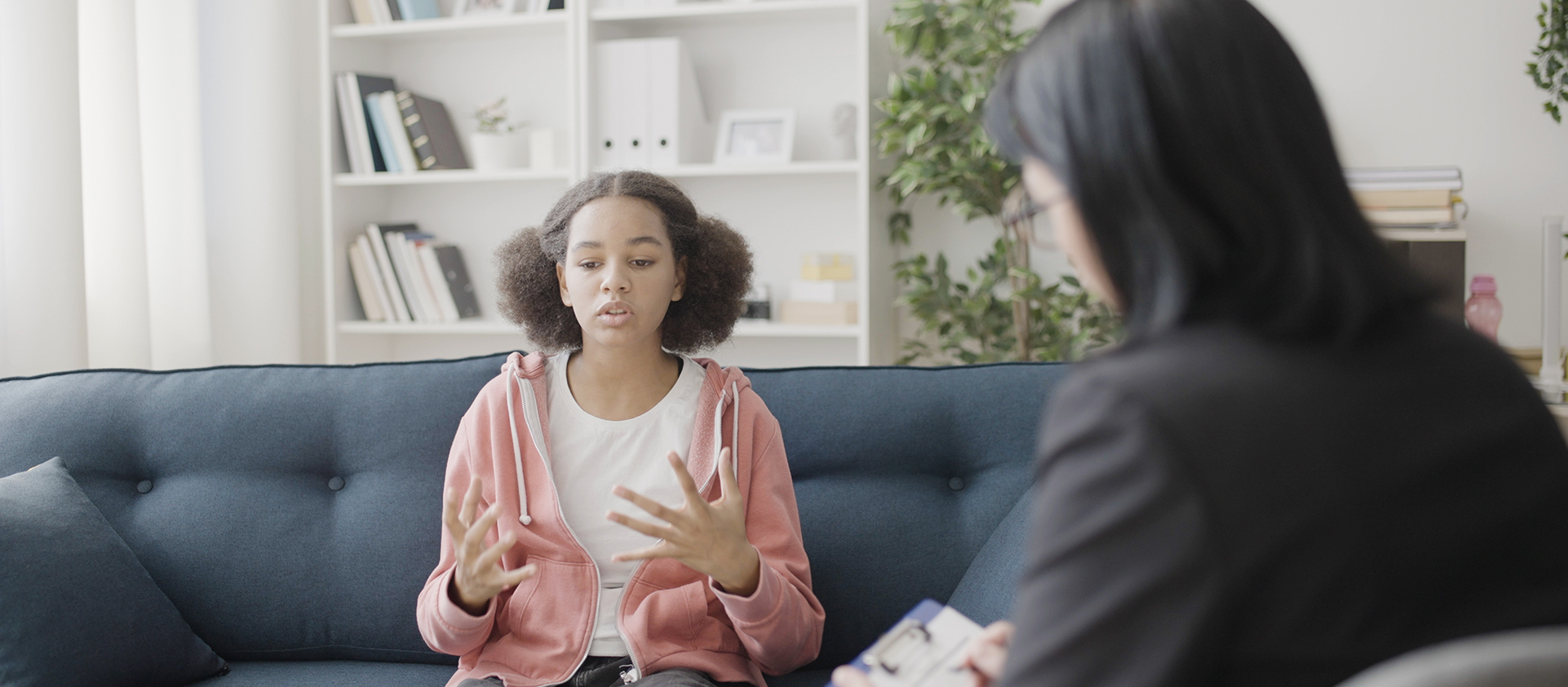
Therapy for children and adolescents differs from adult therapy, and it’s important to find therapists with the knowledge needed to properly treat children, tween, and teen-related issues.Children, tweens and teens are more vulnerable than adults, as they have less control over their environments at home and at school. Children, tweens, and teens also have less control over their own impulses, as they are still getting to know themselves and testing their limits. If your child, tween, or teen is struggling to regulate their emotions, seeing a therapist can help them develop healthy coping skills that they can carry with them into adulthood.
As a result of COVID, rates of depression and anxiety in children, tweens, and teens have increased. The pandemic has affected the ways children can socialize, as well as their family structure. Children’s sense of safety has decreased. Now, children who are able to go to school worry they might bring home an illness that could kill an immunocompromised family member. Additionally, many parents don’t have the emotional availability they once had. Between 2019 and 2021, teen suicide has doubled.
Child and Adolescent Grief Therapy
Children and adolescence struggle just as much as adults do with grief and loss. Children and adolescents typically have very little control over their worlds. They don’t get to choose their home, their school or even what foods they get to eat. Losing a parent or a sibling can be devastating and isolating. Every child responds differently. Suggested readings: how to talk to a child about baby loss
Art therapy helps children, tweens, and teens connect to their emotions in non-verbal ways. It helps people express their inner selves, bypassing verbal language. Art is a completely different medium for expressing energy and emotion. Art therapy helps children, tweens, and teens manage feelings of stress. It teaches a form of mindfulness and a way to release feelings, thoughts, and energy. Art therapy accesses a person’s creativity and critical thinking skills in a way that is different from traditional talk therapy.
Art therapy is especially useful for children, tweens, and teens who don’t feel comfortable talking. It gives them something to do and a focused way of directing their energy. As this process is occurring, an art therapist is able to help the client connect to themselves in a grounded way.
Trauma can happen at any age. With the right support, healing is possible. Our focus is on the child, tween, or teen’s emotional needs, relationships, and surroundings. Our trauma therapists are trained to spot triggers in a child’s environment and seek ways to minimize them while teaching the child how to have more control over their environment. Children by definition are dependent upon others – our job is to help children develop the necessary tools to be able to successfully navigate life’s obstacles. We will work closely with you and your child to help foster an environment that your child will experience as nurturing. Some examples of the benefit of therapy include decreased sleep anxiety, increased self assurance, and self advocacy skills. Depending on the age when trauma occurs, your child may or may not have memories of the event as an adult. How you frame their traumatic experiences may have a significant impact on their healing process.
Recovery from trauma is challenging at any age. Recovery from trauma at an early age requires a lot of love and support. While parents play the most influential overall role in raising their child, a little help from others can speed the healing journey. Sometimes it’s easier for children to receive feedback from people who aren’t their primary caregivers.
Online therapy, also known as telehealth, may be appropriate for tweens and teens. The effectiveness of online therapy is truly dependent upon the skill set that your child needs to develop. In-person therapy is the gold standard for teaching children emotional connection with others. Only through face-to-face contact can the subtler skills of reading emotions be taught. Connecting through a computer is simply not the same as being in the room with another human being. Relationships, while powerful online, do not necessarily prepare a person for the realities of being in the same room with another person.
Therapy that is more skill-focused is easily transferable to online counseling. This is especially true for older children who can practice their skill in the real world and then report back to their therapist each week for deeper understanding. Similarly, family therapy lends itself to online therapy because the therapist literally becomes a voice who can guide the parent and child to connect with one another in new and different ways. The online therapist can coach the parent in real time to engage with their child, tween, or teen.
Only under rare circumstances will we do online individual therapy for children between the ages of 3 and 9. We strongly believe that young children learn best through play. Children need less screen time and more in-person time. Again, there are exceptions to every rule, so call today for a free consultation with one of our child, tween, and teen therapists to discuss your child’s particular needs.
Divorce can be an especially difficult experience for children, tweens, and teens to go through because their brains are still forming. They are still learning to reason and understand abstract concepts. Children, tweens, and teens of divorce often need extra support to process the unresolvable differences they witnessed between their parents. This shift in life circumstances can negatively influence their sense of security – who will be there for them and how do they fit into the world? The lack of stability in their home environment can make them susceptible to feeling distrustful of others and abandoned by those closest to them, causing them to feel confusion about their own identities.
It is common for substance abuse and mental health issues to surface during adolescence. Both sets of issues are strongly affected by stress. Divorce is often experienced as very stressful for children, tweens, and teens and emerging symptoms can be exasperated. The stress from divorce can last for many years after separation has occurred. Oftentimes after divorce, children, tweens, and teens become pawns or are forced to act as the “peace-maker” between two feuding parents. Children, tweens, and teens are frequently left to advocate for themselves.
Additionally, children, tweens, and teens who experience divorce may struggle in school and with friendships. Children, tweens and teens crave a sense of belonging and an understanding for what their role is in the world. As their home environment crumbles, and parents become emotionally preoccupied, children can feel anxious and alone. However, divorce is not necessarily a bad event and may be extremely beneficial to the mental health of each parent, but it can be a significant stressor that triggers underlying issues in children. * Despite the negative effects of divorce on children, staying in an unhealthy marriage can be equally problematic for children. The point is not to encourage parents to stay together for the sake of the child, but rather to understand the unique needs of children, tweens, and teens as their parents divorce.
The goal of therapy for children, tweens, and teens whose parents are divorcing is to help them process their own feelings and thoughts about this challenging life transition. Children do not often have the skills to articulate all their big emotions, and instead may simply say “I hate you” or get into physical fights with their siblings or peers. Additionally, children may have concerns about when or how they will see one of their parents. The therapist is an adult who is focused on the needs of the child. Parents during this time are often too distracted by their own emotions to be fully present to their child. In addition to working directly with the children, we can work with parents on parenting skills. Unfortunately, parenting doesn’t come with a rule book. Parents usually learn by trial and error or by talking to a more seasoned parent.
Each child is an individual with a unique set of circumstances. Exactly how long your child will be in treatment depends upon what symptoms they are presenting with. In general, we recommend treatment to follow the academic year. While this might be longer than many children need, we believe that it takes time to solidify new skills. As an adult, you want to make sure that the child has enough time to practice their new skill in a variety of situations.
With that being said, children change at a much faster rate than adults. The habits of children, tweens, and teens are less ingrained than they are in adults; adolescents are very flexible learners. Early intervention can shift a child’s growth significantly and set them on a much healthier path. Children’s brains are not fully formed, which is why the impact of early intervention is so significant.
Children, tweens, and teens are the hardest hit by loneliness during the COVID pandemic. Adolescence is a time of exploration, a time of friendships, and of increased independence. Instead of independence, COVID adolescents have been asked to isolate. Children, tweens, and teens have been engaged in extended lockdowns, remote schooling, and canceled sports. On top of the loss of seeing friends at school or during after-school activities, parents have had less emotional energy to care for their children. Parents have faced their own set of crises. Many parents lost their jobs or were forced to quit to take care of their children that are now home. “Lucky” parents had flexible jobs, allowing them to work safely from home, but now those parents are struggling to meet the demands of helping a child with online learning while working their regular job. And of course, many children have lost a family member or a loved one due to COVID. To adapt to the changing realities, children have spent many more hours online. While the Internet has been wonderful at connecting us with others, too much internet usage due to the loss of touch/human contact increases feelings of loneliness. Social isolation has had a devastating impact on tweens and teen development.
What is play therapy? Play. We use play therapy to work with children because play is recognized for children as a primary learning tool. Play taps into children’s imagination, curiosity, and wonder. It is through play that they learn to express their own emotions and interact with others.
We believe that through play therapy, children’s self esteem and self-acceptance can improve. Play therapy can help children make meaning of their experiences, explore ways of expressing themselves, and learn how to cope with difficult situations. Traditionally, play therapy involves sand trays, art, music, puppets, and story-telling. At the heart of play therapy is a space where any object can become a toy and any emotion, gesture, or sound can be a form of communication. Play therapists use play as a way of reaching children on their level and working with them in a safe environment that will enable healing.
While most people don’t want to admit their tween, teen, or college-aged child is having sex, sex is happening. In fact, prior to COVID, the average age of children being exposed to online nudity was 7 years old. Now with having lived in lock-down on-and-off for several years, the age is even younger, and children have even less social skills. Why? Because children have been stuck in the house without friends. During COVID there was a major cultural shift – teens during quarantine were suddenly allowed to have their significant others sleep over their own house. Historically parents rarely gave permission for children to have sex in their house. Teens were only allowed to have sex after graduation, or if they were at college, but certainly not sharing a bedroom at home. Why? Because parents were more focused on limiting the number of people their children were in contact with.
Talking to children about sex is hard. What kind of books do you want to expose your children to? And at what age? What do you do when you realize your child is looking at porn? When should you teach them about birth control? At what age, if any, should they be allowed to start dating? Are you okay with your child using a tampon or do you prefer them to use pads? At what age should children of the opposite gender stop going into public restrooms with you? The list is endless.
Psychotherapy for tweens and teens is the same as therapy for adults. However, the therapist has specialized training in adolescent development. This knowledge shifts the dialogue between the child / tween / teen and the therapist. Adolescents who are between the ages of 9 and11 begin developing best friends, seeing the perspectives of others, and becoming more aware of peer pressure. Adolescents between the ages of 12 and 14 are increasingly independent from their parents and more dependent upon their peers for approval. Due to hormones, they may experience increased moodiness and seek out more privacy. Teens between the ages of 15 and 17 tend to be more interested in dating and sexuality. They often spend even more time with friends, and their ability to frameshift and empathize with others is much more developed.
With advances in technology and the accessibility of social media, comparison culture is at an all-time high. Many children, tweens, and teens are suffering from self-esteem issues, depression, and anxiety. Children, tweens, and teens are feeling more pressure to be perfect now more than ever, with an internet audience judging their performance. Being a tween or teen has always had its challenges in regards to grappling with identity issues, emerging sexuality, feeling connected, and managing relationships. However, more than ever, children, tweens, and teens are experiencing high levels of stress, anxiety, and depression that interferes with their daily functioning. If your child or adolescent is having a hard time in their day-to-day life, it might be time to find a qualified child and adolescent therapist.
 Support Group Calendar